
By: Ryan Mueller
For years, loss prevention in pharmacy environments was viewed through a relatively narrow lens: reduce shrink, prevent diversion, investigate internal theft, and protect inventory.
While those responsibilities still exist, a recent article in Loss Prevention Magazine highlighted something that many pharmacy security leaders already know: pharmacy loss prevention has evolved into something far bigger.
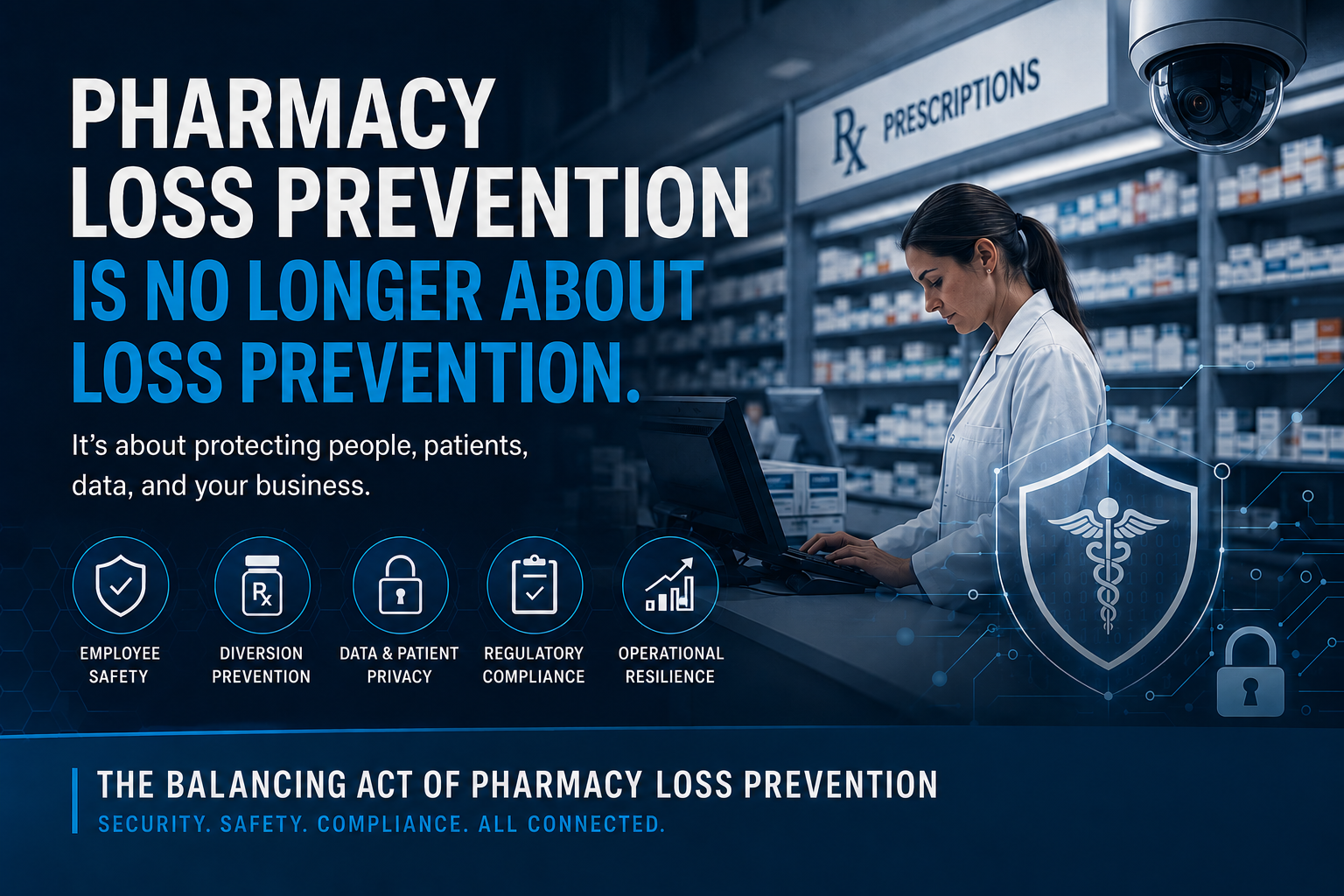
Today, pharmacy LP sits at the intersection of employee safety, patient privacy, regulatory compliance, operational continuity, fraud prevention, and physical security.
In other words, pharmacy loss prevention isn’t really about loss prevention anymore.
It’s about enterprise risk management.
The Stakes Are Different in Pharmacy
One of the biggest takeaways from the article is that pharmacy environments operate under a completely different risk profile than traditional retail.
When a retailer loses a pallet of merchandise, the impact is largely financial.
When a pharmacy loses controlled substances, the consequences can include:
- Regulatory investigations
- DEA scrutiny
- Compliance violations
- Patient safety concerns
- Reputational damage
- Potential criminal liability
That reality changes how organizations must think about security.
Security teams can no longer focus solely on what was lost. They must focus on what the incident means for the business as a whole.
The organizations that understand this distinction will be better positioned to manage risk in today’s increasingly complex healthcare environment.
Employee Safety Has Quietly Become the Biggest Issue
While diversion and theft often dominate headlines, one of the most important themes discussed in the article was employee safety.
Pharmacy employees today face challenges that simply were not as prevalent twenty years ago.
The rise in aggressive customer interactions, prescription fraud attempts, organized theft activity, and robberies targeting controlled substances has created a new threat environment.
For security leaders, this raises an important question:
Are we spending enough time protecting the people who protect the medications?
Many organizations have invested heavily in cameras, access controls, alarms, and physical security infrastructure. Those investments matter.
However, the article reinforces something we often see across multiple industries: technology alone does not create safer environments.
Training, response planning, communication protocols, and employee preparedness are often what determine how effectively an organization responds when an incident occurs.
The strongest security programs balance physical security investments with investments in people.
The Future of Investigations Is Data
Another takeaway that stood out is the growing role data analytics plays in identifying internal theft and diversion.
Historically, many investigations started with observations, tips, or suspicious behavior.
Today, the signals often appear in the data first.
Inventory discrepancies.
Prescription trends.
Override patterns.
Audit exceptions.
Unusual employee activity.
As pharmacy operations become increasingly digitized, security leaders will need to become more comfortable using data to identify risk before it becomes a major incident.
This trend is not unique to pharmacy. Across retail, healthcare, logistics, and critical infrastructure, the future of loss prevention is becoming increasingly intelligence-driven.
The organizations that learn how to leverage data effectively will gain a significant advantage in both prevention and investigation.
Compliance and Security Are No Longer Separate Functions
One point the article makes repeatedly is that pharmacy LP teams are being asked to operate in highly regulated environments where every decision carries compliance implications.
This is something security professionals across all industries should pay attention to.
The traditional model of security operating independently from compliance, legal, HR, and operations is becoming increasingly outdated.
The most effective organizations are building integrated risk management programs where departments work together rather than in silos.
In pharmacy environments especially, a security incident is rarely just a security incident.
A diversion case may also be:
- A compliance issue
- A patient safety issue
- A legal issue
- A privacy issue
- A reputational issue
Treating those risks separately creates gaps.
Managing them together creates resilience.
What Security Leaders Should Take Away
The biggest lesson from this article is simple:
The scope of pharmacy loss prevention has expanded dramatically, but many organizations still approach it with yesterday’s mindset.
The future belongs to organizations that recognize security as a business function rather than a standalone department.
That means investing in:
- Employee safety programs
- Intelligence and analytics capabilities
- Cross-functional collaboration
- Compliance integration
- Proactive risk identification
- Operational resilience
The pharmacies that succeed will not necessarily be the ones with the most cameras or the largest security budgets.
They will be the ones that understand how deeply connected security, compliance, safety, and operations have become.
Final Thoughts
One quote from the article stood out above all others:
“The job today is genuinely unrecognizable from what it was twenty-five years ago.”
That statement applies far beyond pharmacy loss prevention.
Across every sector, security professionals are being asked to do more than ever before. They are expected to understand technology, compliance, workplace violence, investigations, intelligence, business continuity, and enterprise risk.
Pharmacy loss prevention simply happens to be one of the clearest examples of where the profession is headed.
The organizations that embrace that evolution will be better prepared to protect their people, their patients, and their business in the years ahead.