
By: Ryan Mueller
Artificial Intelligence (AI) is quickly becoming one of the most influential technologies shaping the future of Asset Protection. Across the retail industry, organizations are exploring how AI can improve investigations, strengthen data analysis, increase operational efficiency, and help security teams make faster, more informed decisions.
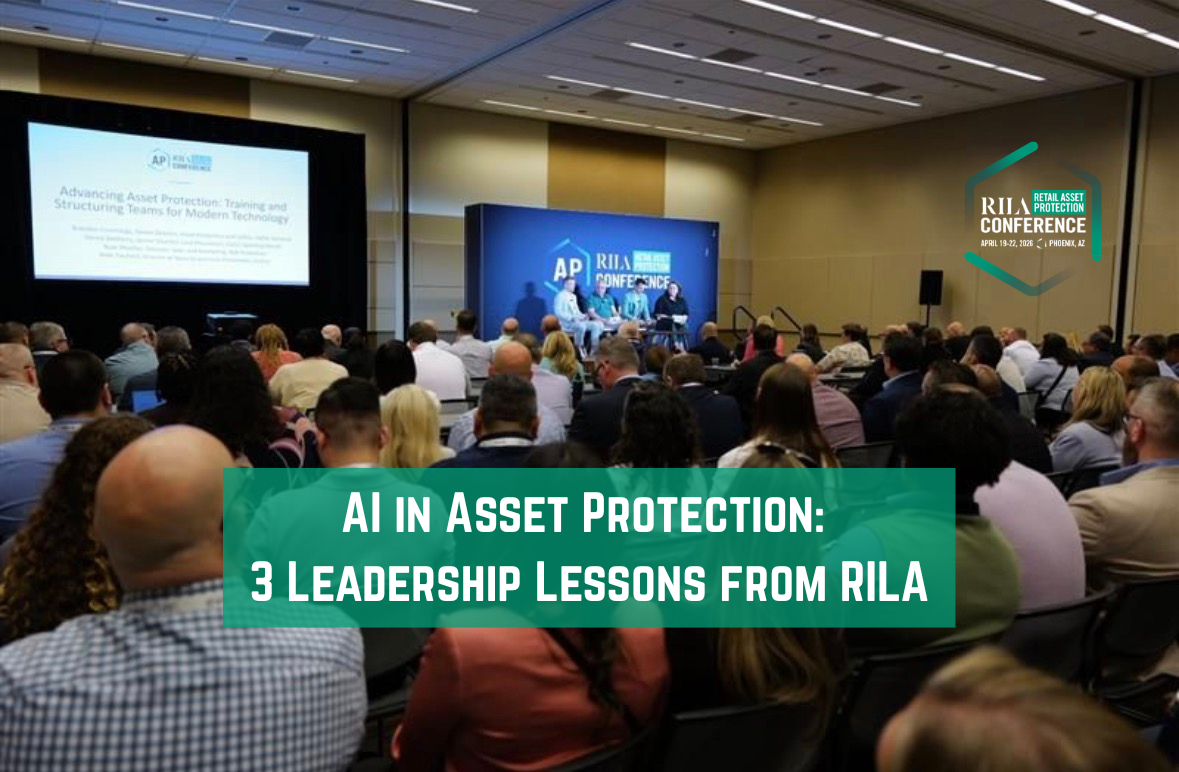
Earlier this year, I had the privilege of moderating a panel on AI in Asset Protection at the RILA Asset Protection Conference alongside senior leaders from Costco, Dick’s Sporting Goods, and Dollar General. Together, we discussed how Artificial Intelligence is influencing today’s Asset Protection organizations and where it may take our profession in the years ahead.
While every retailer represented on the panel was at a different stage of its AI journey, the conversation consistently returned to the same themes. The biggest lessons weren’t about technology itself. They were about leadership, trust, adaptability, and solving meaningful business problems.
Those discussions reinforced several beliefs I already had about AI, and more importantly, they highlighted where I believe Asset Protection is headed over the next several years.
Here are the three biggest observations I walked away with from moderating that discussion.
AI in Asset Protection Starts with People, Not Technology
One of the strongest themes throughout our discussion was that successful AI adoption has very little to do with the technology itself.
When people hear “Artificial Intelligence,” they often think about computer vision, predictive analytics, automation, or machine learning. Those technologies are certainly changing the industry, but they weren’t the center of the conversation. People were.
How do organizations introduce AI without creating fear?
How do leaders build trust?
How do teams understand that AI is designed to enhance their work rather than replace it?
Those questions are far more important than selecting the newest software platform.
Every retailer emphasized that AI should eliminate repetitive work, process larger volumes of data, and provide better insights so Asset Protection professionals can spend more time where they create the greatest value—conducting investigations, coaching stores, partnering with operations, and protecting people.
One of the biggest misconceptions surrounding AI is that it will replace Asset Protection professionals.
I believe the opposite is true.
AI can recognize patterns, identify anomalies, and analyze enormous amounts of information far faster than any person. What it cannot replace is experience, judgment, leadership, and the ability to make informed decisions.
Technology can accelerate decision-making.
People remain responsible for making the decisions.
Organizations that invest in change management, communication, and employee development alongside AI will ultimately see the greatest return from their technology investments.
AI Should Solve Business Problems, Not Become the Business Strategy
Another theme that surfaced repeatedly throughout the panel was that the most successful organizations aren’t implementing AI simply because it’s available.
They’re implementing it because they’re solving specific business challenges.
That distinction matters.
Too often, organizations begin by asking:
“Where can we use AI?”
A much better question is:
“What problem are we trying to solve?”
Whether the objective is improving investigations, identifying fraud patterns, analyzing exception data, reducing manual work, or helping field teams prioritize risk, AI should always support a clearly defined business objective.
Technology should never become the strategy.
Business outcomes should.
This mindset also changes how organizations evaluate solution providers.
Rather than chasing the newest features, successful Asset Protection leaders focus on measurable outcomes, operational improvements, return on investment, and solutions that integrate into existing business processes.
Artificial Intelligence is an incredibly powerful tool, but like every technology before it, its value is determined by how effectively organizations apply it to real business challenges.
The Future of Asset Protection Leadership Is Already Changing
Perhaps the most interesting part of our discussion wasn’t about technology at all.
It was about leadership.
As the conversation shifted toward hiring, developing teams, and preparing for the future, one thing became clear.
No one talked about hiring AI experts.
Instead, we discussed the importance of curiosity.
Adaptability.
Continuous learning.
Cross-functional collaboration.
Business acumen.
Those qualities are becoming increasingly important as Asset Protection continues evolving beyond traditional investigations and shrink reduction.
Today’s leaders are expected to partner with Legal, IT, Operations, Human Resources, Marketing, Finance, and executive leadership. They’re interpreting data, influencing business strategy, and helping organizations responsibly adopt emerging technologies.
That’s a very different role than our profession held even ten years ago.
The future Asset Protection professional won’t simply understand investigations or security technology.
They’ll understand how security supports the business.
They’ll know how to communicate across departments.
They’ll embrace innovation without losing sight of the human element.
Most importantly, they’ll remain curious enough to keep evolving as our profession evolves.
The Bottom Line
After moderating a discussion with senior Asset Protection leaders from three of the world’s largest retailers, one thing became very clear.
Artificial Intelligence isn’t redefining Asset Protection because of the technology itself.
It’s redefining how we think about leadership.
The organizations that will benefit most from AI won’t necessarily be the ones with the biggest technology budgets or the newest software.
They’ll be the ones that build trust with their teams, solve meaningful business problems, invest in continuous learning, and use AI to empower people rather than replace them.
Asset Protection has always been about protecting people, reducing risk, and enabling the business to succeed.
AI doesn’t change that mission.
It simply gives us another powerful tool to accomplish it more effectively.
Watch the Full RILA Session
Interested in hearing the full conversation? Click here to watch the complete panel discussion.