
By Ryan Mueller
Artificial intelligence has become one of the most talked-about topics in the security industry.
Walk any trade show floor, open any industry publication, or sit through a vendor presentation and you’ll hear the same message: AI is transforming security.
But beneath the buzzwords and bold claims lies a much more important question:
Is AI actually delivering measurable value?
That question was at the center of a recent ISC West session titled AI in Live Video Monitoring—ROI Without the Hype. The discussion focused less on futuristic concepts and more on what security leaders actually care about: reducing costs, improving response times, and increasing operational efficiency.
The conclusion was surprisingly simple.
AI is creating value today, but not in the ways many people think.
The Most Valuable AI Use Case Isn’t What Most People Expect
When people hear AI in security, their minds often jump to fully autonomous monitoring centers, predictive threat detection, or systems that can operate without human involvement.
The reality is much less glamorous.
And much more valuable.
The most successful AI deployments today are focused on one thing:
Reducing false alarms.
For years, monitoring centers have been flooded with nuisance alerts generated by weather, animals, lighting changes, shadows, and countless other non-threat events.
Every false alarm consumes operator time.
Every unnecessary dispatch costs money.
Every distraction increases the risk of missing a legitimate security event.
According to the session, organizations are seeing:
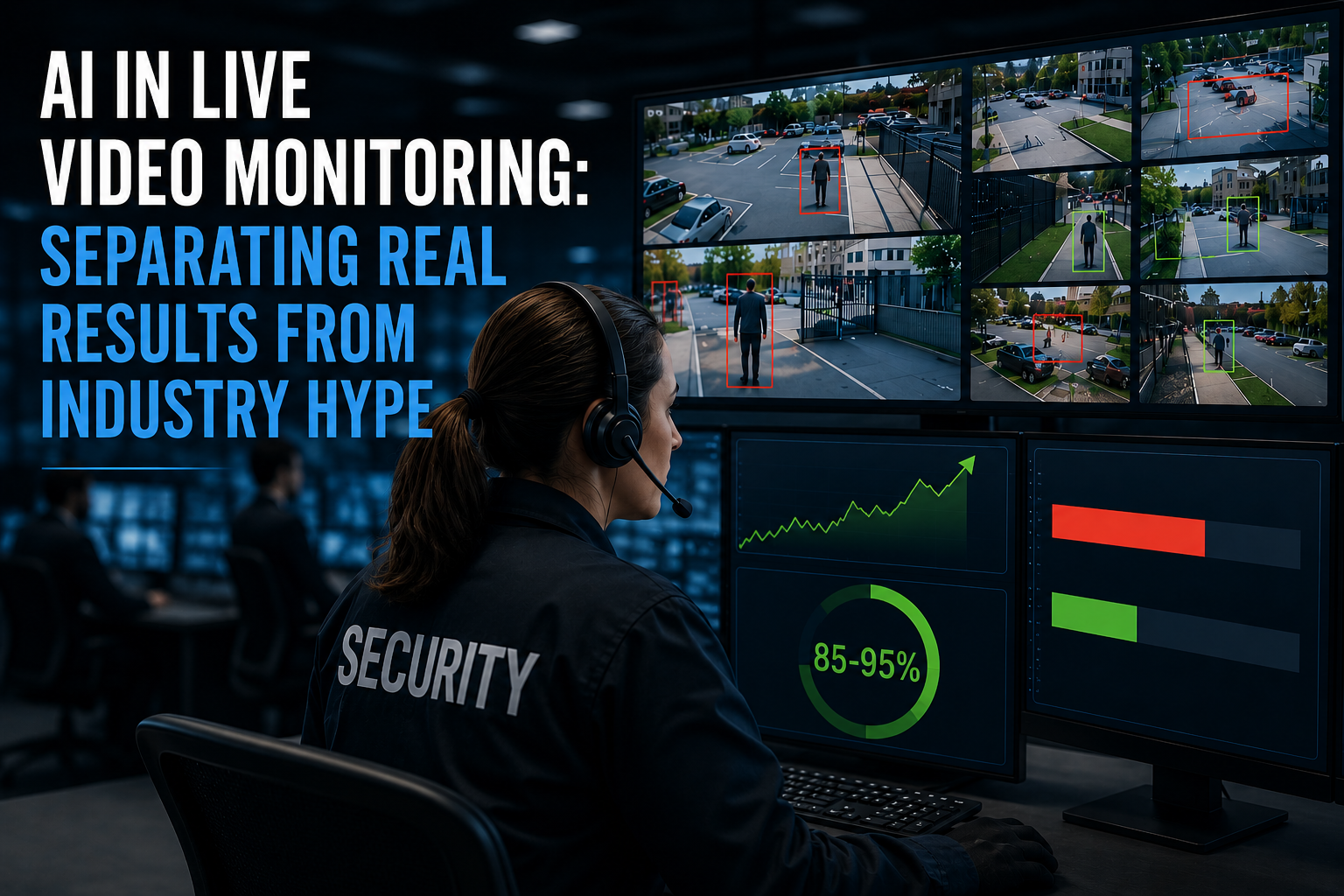
- 85% to 95% reductions in false alarms
- Faster event verification
- Increased operator productivity
- Lower dispatch costs
- Improved response times
In many cases, the return on investment is realized within months rather than years.
That is a much more compelling business case than simply saying a system has AI capabilities.
AI Isn’t Replacing Security Professionals
One of the most memorable moments from the session came when the speaker compared AI to a highly motivated intern.
The analogy was surprisingly accurate.
AI can process massive amounts of information quickly.
It can identify patterns.
It can filter noise.
It can make recommendations.
But it still lacks the situational awareness, judgment, and decision-making capabilities that experienced security professionals bring to the table every day.
An AI system may recognize that someone is walking across a property.
A trained operator can determine whether that individual is an employee, a contractor, a customer, or a legitimate threat.
That distinction matters.
At least for the foreseeable future, AI works best when paired with experienced security personnel rather than replacing them.
The strongest security programs will combine technology and human expertise, not choose one over the other.
The Industry Has an Adoption Problem, Not a Technology Problem
One of the most interesting statistics shared during the session highlighted a major disconnect in the market.
Nearly every security technology provider now promotes some form of AI capability.
Yet actual deployment rates remain significantly lower.
The technology exists.
The demand exists.
The adoption does not.
Why?
Because many organizations still struggle with:
- Implementation complexity
- Trust in AI-generated decisions
- Data privacy concerns
- Integration challenges
- Unclear return on investment
This creates a significant opportunity for security integrators and service providers.
Organizations are not looking for more AI features.
They are looking for trusted partners who can help them deploy AI effectively and produce measurable outcomes.
The companies that bridge this gap will be the ones that capture the most value over the next several years.
The Biggest Mistake Companies Make
Many organizations approach AI as a standalone project.
They view it as something entirely separate from their existing security infrastructure.
That approach often creates unnecessary complexity.
A better strategy is to layer AI onto existing systems.
Rather than replacing cameras, monitoring processes, or operating procedures, successful deployments enhance what is already working.
This approach offers several advantages:
- Lower implementation costs
- Faster deployment timelines
- Reduced operational disruption
- Faster user adoption
- Easier ROI measurement
Organizations can begin with a specific challenge, such as false alarm reduction, validate the results, and then expand their use of AI over time.
The incremental approach consistently delivers stronger outcomes than attempting a complete transformation all at once.
Where the Hype Still Outpaces Reality
The session also challenged several popular narratives currently circulating throughout the industry.
Some of the most discussed AI applications remain largely unproven in real-world security environments.
Examples include:
- Fully autonomous security operations centers
- AI-driven real-time threat response without human review
- Emotion detection technologies
- Predictive policing applications
- Generative AI controlling live security decisions
While these concepts generate attention, many still face significant technical, regulatory, and operational hurdles.
That does not mean they will never become viable.
It simply means they are not delivering widespread, proven value today.
Security leaders should focus their investments on practical applications with demonstrated outcomes rather than chasing the latest headline.
The Future Belongs to Service-Based Security Models
Perhaps the most important strategic takeaway from the session had little to do with AI itself.
It had everything to do with business models.
Historically, much of the security industry has been driven by hardware sales.
That model is changing.
As AI, cloud platforms, analytics, and managed services continue to expand, recurring revenue is becoming increasingly valuable.
Organizations are no longer purchasing cameras alone.
They are investing in outcomes.
They want:
- Better visibility
- Faster response
- Lower risk
- Improved efficiency
- Measurable business value
AI becomes most powerful when it is delivered as part of a broader service offering rather than sold as an isolated technology.
The future belongs to providers who can combine technology, expertise, and operational execution into a complete solution.
Focus on Results, Not Features
The conversation around AI in security often becomes overly focused on technical capabilities.
But clients rarely buy technology because of its features.
They buy solutions because of the results they produce.
The organizations achieving success with AI today are not necessarily using the most advanced platforms.
They are using technology to solve specific operational problems.
They are reducing false alarms.
They are improving response times.
They are increasing efficiency.
And they are creating measurable value.
That is where AI is making the biggest impact today.
Not through hype.
Through results.
Bottom Line
AI is rapidly becoming a valuable tool within modern security operations, but its greatest strength is not replacing people—it is helping them work more effectively. The most successful deployments focus on practical outcomes such as false alarm reduction, operator efficiency, and faster response times rather than chasing futuristic concepts. As adoption continues to grow, organizations that prioritize implementation, execution, and measurable results will gain far more value than those simply investing in the latest technology. In security, the future will belong to those who use AI to enhance operations, not those who rely on it to replace them.