
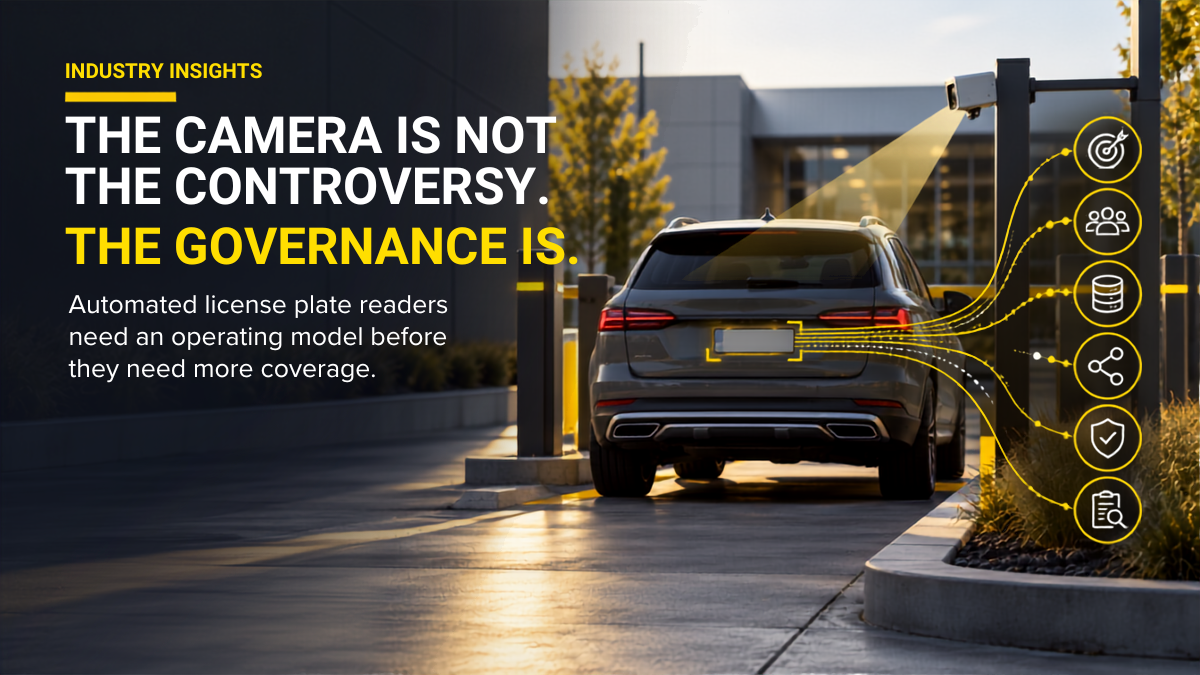
Why automated license plate readers need an operating model before they need more coverage
By Ryan Mueller
Automated license plate readers can do something security teams have wanted for years: turn vehicle movement into searchable, actionable information.
That can be useful. It can also become a problem quickly.
The dividing line is not the camera.
It is the governance around the data.
Within the past three weeks, two influential industry organizations made that point from different sides of the security ecosystem. The International Association of Chiefs of Police issued an official statement on responsible ALPR use on August 20. The Security Industry Association followed with detailed policy principles on September 9.
Both support legitimate uses of the technology. Both also call for strong controls around purpose, access, retention, sharing, verification, security, and audits.
That agreement should get the attention of every organization considering ALPR, including private enterprises.
ALPR Is Not Just a Camera System
At the device level, the concept is straightforward. A camera captures a plate. Software converts the image into machine-readable characters. The system can compare the result with an approved list or make the record searchable later.
But that description leaves out the part that creates the most risk.
An ALPR record can include more than a plate number. Depending on the system and use case, it may also include an image, date, time, location, direction of travel, vehicle characteristics, and associated event information.
One read is a moment.
Many reads, retained and connected over time, can become a pattern.
That is why ALPR should be treated as a governed data system, not simply another video device on the network.
The Industry Is Converging on the Same Controls
SIA and IACP do not represent the same constituency. Their recent guidance still overlaps in important ways.
Responsible programs should have:
- A documented and lawful purpose
- Access limited to trained, authorized users
- Defined retention and deletion rules
- Controlled sharing under written terms
- Cybersecurity and data-integrity protections
- Human verification before consequential action
- Audit logs and supervisory review
- Testing, maintenance, and accuracy controls
- Clear consequences for misuse
That is not a feature list. It is an operating model.
Oregon’s 2026 SB 1516 makes the point even more concrete for law-enforcement use. The enacted measure limits authorized uses, generally caps retention at 30 days unless the data is tied to an ongoing investigation or court proceeding, requires policies for use and vendor contracts, restricts some sharing, and establishes remedies for violations.
No single state law defines the rules for every organization. But it shows where expectations are heading: purpose must be specific, access must be controlled, sharing must be visible, and the vendor cannot sit outside accountability.
An Alert Is a Lead, Not a Verdict
This may be the most important operating principle in the entire discussion.
Both SIA and IACP say ALPR output should not be treated as conclusive evidence. A plate read can be wrong. A list can be stale. A vehicle can have a different driver. A plate can be obscured, altered, or read from the wrong jurisdiction.
The system may be fast. The decision still needs judgment.
Before an ALPR alert drives a consequential response, the organization should define what must be confirmed. That could include:
- The plate image and characters
- The issuing jurisdiction
- The current status of the source record
- The time and location of the read
- Whether the vehicle, plate, and person are actually connected
- Whether the proposed action is permitted under policy
Human oversight is not friction to remove. It is part of the control.
Retention Should Have an Answer, Not a Default
Ask a simple question during procurement: How long is the data kept?
If the answer is “whatever the platform default is,” the program is not ready.
Retention should match a documented need. A private parking facility, a gated distribution center, a residential community, and a public roadway network are not interchangeable use cases. They should not inherit the same settings simply because the same technology can serve them.
Leaders should decide:
- Which reads are retained
- How long unmatched data remains available
- When an event record may be preserved longer
- Who can approve an exception
- How deletion is verified
- Whether backups and exports follow the same rule
Data that no longer serves an approved purpose does not become more valuable by sitting in storage. It becomes harder to defend.
Sharing Is Where Control Gets Complicated
Multi-location organizations rarely operate in a closed environment. They may use a cloud platform, an integrator, a monitoring partner, local security teams, property managers, law enforcement, or other authorized third parties.
Every connection can expand the usefulness of the system.
Every connection can also expand the number of people, policies, jurisdictions, and retention rules touching the data.
A responsible sharing model should answer:
- Who can receive the data?
- For what documented purpose?
- Is sharing automatic or approved case by case?
- Can the recipient share it again?
- Which retention rule follows the record?
- Is each disclosure logged?
- Can access be revoked immediately?
- What happens when a contract ends?
“The vendor handles that” is not governance. It is a blind spot.
The Vendor Contract Is Part of the Security Architecture
Security teams often evaluate ALPR around field of view, capture rate, nighttime performance, integrations, alerts, and search.
Those questions matter. They are not enough.
The contract and technical configuration should also establish:
- Data ownership and permitted use
- Vendor and subcontractor access
- Encryption and authentication requirements
- User roles and least-privilege controls
- Export, deletion, and contract-termination procedures
- Sharing defaults and downstream restrictions
- Audit-log availability and integrity
- Incident-notification responsibilities
- Configuration, testing, and maintenance expectations
- Evidence needed to verify compliance
The strongest promise in a proposal means very little if the platform cannot produce an access log, enforce a retention rule, or explain where the data travels.
Six Questions to Ask Before Expanding ALPR
Before adding more readers or more locations, security leaders should be able to answer six questions in plain language.
- What exact problem are we solving? Define the use case narrowly enough to test whether the system is working.
- What data are we collecting? Document the full record, not just the plate number.
- Who can use it, and why? Connect every role and query type to an approved purpose.
- How long do we keep it? Set a retention rule based on need, jurisdiction, and risk.
- Who can receive it? Map internal, vendor, partner, and public-agency sharing.
- Can we prove the controls work? Test alerts, permissions, logs, deletion, sharing, and offboarding.
If those answers live in five departments and three vendor portals, they do not yet form one program.
The Bottom Line
ALPR can help security teams recognize a vehicle of interest, investigate an event, manage access, or understand movement around a site.
But useful technology does not earn trust on its own.
Trust comes from the decisions around it: a clear purpose, limited access, proportionate retention, controlled sharing, human verification, visible audits, and a vendor relationship that can withstand scrutiny.
The next generation of physical security will collect more data, connect more systems, and make more recommendations.
The organizations that lead will not be the ones that collect the most.
They will be the ones that can explain exactly why they collect it, who can use it, and what happens next.
Sources & Further Reading
- Security Industry Association Calls for the Responsible and Effective Use of Automated License Plate Reader Technology — Security Industry Association, September 9, 2026.
- Automated License Plate Reader Technology: Policy Principles and Guidance — Security Industry Association, accessed September 14, 2026.
- IACP Statement on the Responsible Use of Automated License Plate Recognition Technology — International Association of Chiefs of Police, August 20, 2026.
- SB 1516, 2026 Regular Session — Oregon Legislative Information System, enacted as Chapter 77 in 2026.
- Automatic License Plate Readers: Legal Status and Policy Recommendations for Law Enforcement Use — Brennan Center for Justice, September 10, 2020.
Editorial note: This article is educational and does not provide legal advice. Organizations should confirm requirements with qualified counsel for the jurisdictions and use cases involved.