
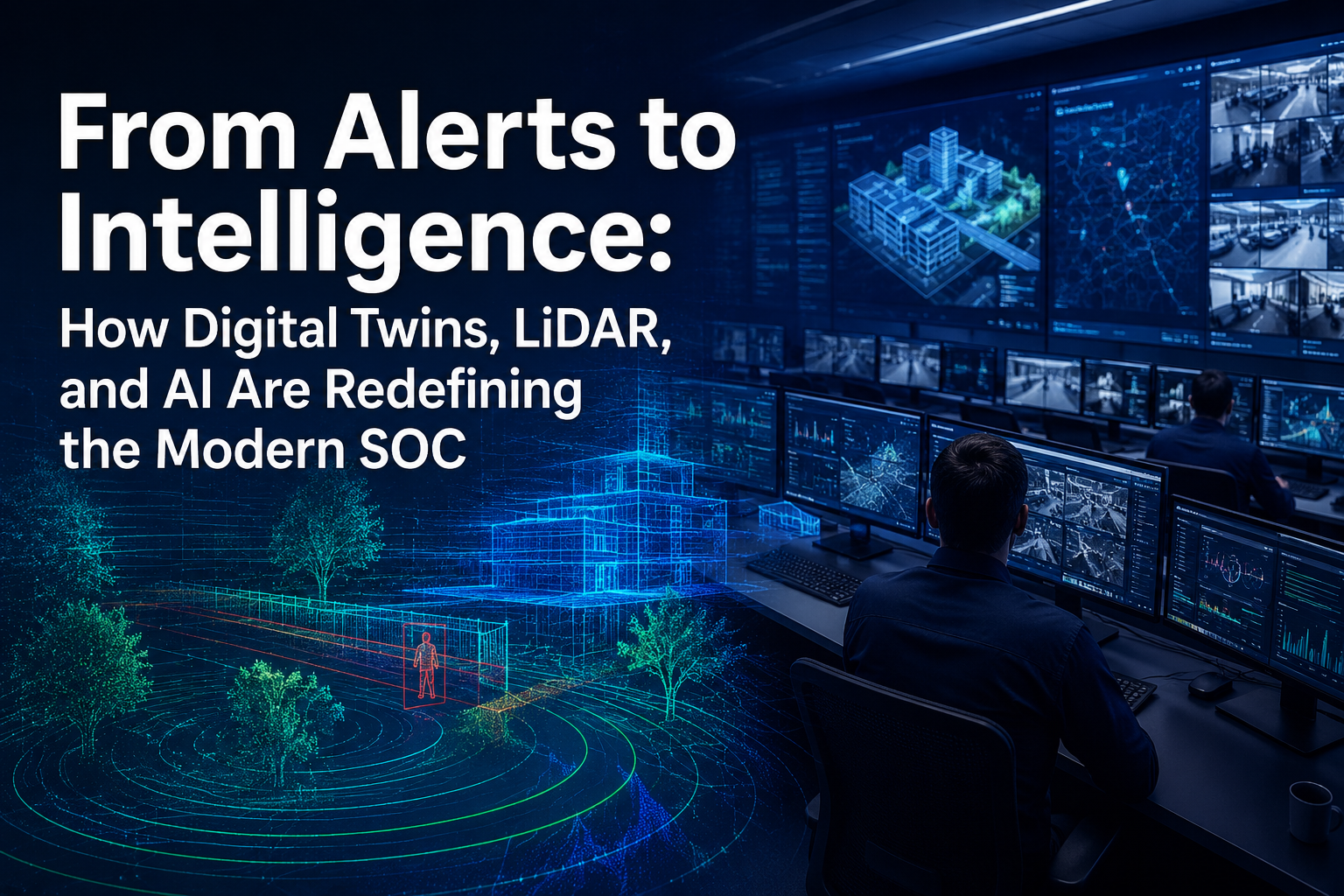
(Because More Data Doesn’t Create Better Security. Better Context Does.)
By Ryan Mueller
For years, Security Operations Centers (SOCs) have been built around a simple concept: monitor, detect, and respond.
Add more cameras. Add more sensors. Add more alerts.
The assumption was that more visibility would lead to better security.
Instead, many organizations found themselves facing a different challenge: information overload.
Operators are often tasked with monitoring dozens, hundreds, or even thousands of devices across multiple systems. Cameras, access control, perimeter detection, environmental sensors, and analytics platforms all generate data. The problem is that data alone does not create situational awareness.
It creates noise.
At ISC West, one session explored how the next generation of SOCs is evolving beyond traditional monitoring by combining digital twins, LiDAR, and artificial intelligence into a more intelligent operating environment. The discussion highlighted a major shift taking place across the industry: security teams are moving from simply seeing events to truly understanding them.
The Problem with Traditional SOCs
Most security operations centers were designed around individual systems.
A camera produces video.
An access control system generates events.
A perimeter sensor triggers an alert.
Each technology performs its own function, often independently of the others.
While these systems provide valuable information, operators are left with the difficult task of piecing together what is happening in real time. As environments become larger and more complex, that challenge becomes increasingly difficult.
The result is often:
- Alarm fatigue
- Slower response times
- Missed events
- Increased operational complexity
- Higher staffing demands
Many organizations are discovering that adding more technology without improving context simply creates more information to manage.
The future SOC requires something different.
It requires understanding.
Digital Twins Create a Common Operating Picture
One of the most discussed technologies during the session was the digital twin.
Unlike a traditional map or static 3D model, a digital twin is a living representation of a physical environment. It continuously incorporates information from cameras, sensors, building systems, and other connected technologies to create a real-time view of operations.
Think of it as a digital version of your facility that updates as conditions change.
Instead of viewing events through isolated camera feeds or alarm lists, operators can see incidents within the context of the entire environment.
This creates several advantages:
- Improved situational awareness
- Faster decision-making
- Better collaboration between stakeholders
- More intuitive operator experiences
- Enhanced incident response coordination
When everyone is working from the same operational picture, communication becomes clearer and decisions become faster.
Perhaps more importantly, digital twins help security teams understand not only what is happening, but where it is happening and what impact it may have on surrounding assets or operations.
Why LiDAR Is Becoming an Important Security Sensor
Many security professionals are familiar with cameras, radar, and traditional perimeter detection systems.
LiDAR introduces a different capability.
Rather than relying solely on images, LiDAR creates highly accurate three-dimensional representations of objects and environments. It measures depth, distance, and movement with exceptional precision, providing spatial awareness that traditional video systems cannot achieve on their own.
This becomes especially valuable in complex security environments.
LiDAR can help:
- Improve perimeter intrusion detection
- Reduce false alarms
- Track movement across large areas
- Enhance object classification
- Support real-time spatial awareness
The technology is increasingly being deployed in environments such as:
- Data centers
- Utilities
- Transportation hubs
- Airports
- Critical infrastructure sites
- Industrial facilities
One of the most compelling concepts discussed during the session was that LiDAR helps security systems understand the environment in three dimensions rather than two.
Security teams do not operate in a flat world.
LiDAR helps systems recognize that reality.
The Real Power Comes from Sensor Fusion
One theme was repeated throughout the discussion.
No single technology solves every security challenge.
Not cameras.
Not AI.
Not LiDAR.
Not access control.
The greatest value comes when multiple technologies work together.
LiDAR provides spatial intelligence.
Video provides visual confirmation.
Access control provides identity information.
Environmental sensors provide additional context.
Together, these technologies create a more complete understanding of what is happening within a facility.
This concept, often referred to as sensor fusion, is becoming a foundational element of modern security design.
Rather than operating as independent tools, security technologies become part of a larger ecosystem.
The outcome is not more data.
The outcome is better information.
AI Is Turning Data into Actionable Intelligence
Artificial intelligence has become one of the most talked-about technologies in the security industry.
Unfortunately, it has also become one of the most misunderstood.
The session emphasized that AI should not be viewed as a tool that simply generates more alerts.
If AI only creates additional notifications, it may actually increase operator fatigue rather than reduce it.
Instead, the role of AI is to help answer critical questions:
What happened?
Why does it matter?
What should happen next?
Modern AI systems are increasingly capable of:
- Detecting events
- Correlating information from multiple systems
- Adding context to incidents
- Prioritizing threats based on risk
This shift is significant.
Security teams are moving away from reviewing endless streams of alerts and toward receiving information that has already been analyzed and prioritized.
In other words, the focus is shifting from data to intelligence.
And intelligence is what drives better decisions.
Reducing Noise May Be the Biggest Opportunity
One of the strongest messages from the session had little to do with technology.
It had to do with people.
Many organizations struggle because operators are overwhelmed by the volume of information flowing into the SOC.
Thousands of alarms each month can quickly create alert fatigue. When every alert appears important, eventually none of them feel important.
The next generation of security technology is designed to solve that problem.
Digital twins provide context.
LiDAR provides spatial awareness.
AI helps determine what deserves attention.
Together, these technologies help reduce noise and elevate meaningful events.
That may ultimately be their greatest value.
Not creating more information.
Creating clarity.
The Future SOC Is About Better Decisions
The session concluded with an important reminder.
Organizations should not focus on buying technology for the sake of technology.
They should focus on outcomes.
The most successful security programs begin with clear objectives and then identify the technologies that best support those goals.
Digital twins, LiDAR, and AI are powerful tools, but their value is only realized when they are integrated into a strategy that improves operational performance.
The future SOC will not be defined by the number of cameras it manages or the number of alerts it processes.
It will be defined by how effectively it helps people make decisions.
And that is where the industry is heading.
From monitoring to understanding.
From alerts to intelligence.
From reactive security to proactive operations.