
By Ryan Mueller
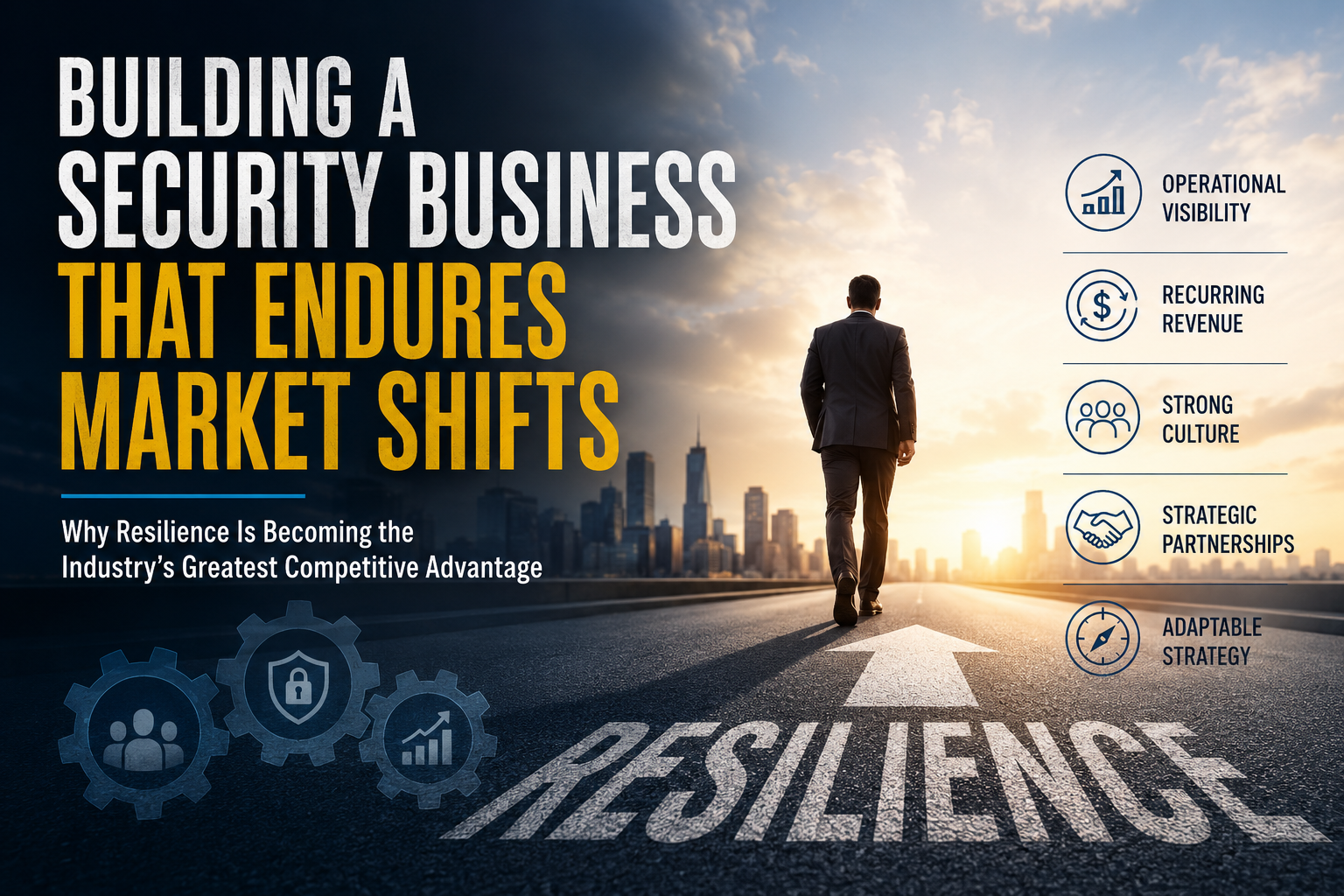
Why Resilience Is Becoming the Industry’s Greatest Competitive Advantage
For years, many security companies built their businesses around growth.
More projects.
More clients.
More expansion.
More hiring.
But today, security business market shifts are forcing organizations to rethink how they operate, scale, and prepare for uncertainty.
As security business market shifts continue accelerating across the industry, resilience is becoming just as important as growth.
And during strong markets, traditional growth strategies often worked.
But one of the clearest themes from ISC West this year was that growth alone is no longer enough.
The companies that endure market shifts are not simply the ones growing the fastest.
They are the ones built to adapt when conditions change.
Because uncertainty is no longer occasional.
It has become part of the operating environment.
- Economic pressure
- Supply chain instability
- Labor shortages
- Technology disruption
- Changing customer expectations
The market is constantly shifting.
And resilience is becoming one of the most valuable assets a security business can build.
Data Visibility Is Becoming a Survival Tool
One of the strongest themes throughout the session was the importance of visibility into the business.
Not assumptions.
Not instincts alone.
Real operational and financial data.
The panel repeatedly emphasized the role of KPIs, forecasting, backlog tracking, and recurring revenue in helping organizations navigate uncertainty with confidence.
Because when markets tighten, companies without visibility often overreact.
And overreaction creates long-term damage.
The businesses that remain stable are the ones that understand their numbers well enough to make strategic decisions instead of emotional ones.
Everything from service response times to average revenue per call to backlog forecasting was discussed as part of building operational stability.
And importantly, the panel stressed that KPIs should not live only at the executive level.
The most successful organizations are creating ownership across the business.
That includes:
- Operations teams
- Service departments
- Accounting
- Sales
- Project management
Everyone understands the numbers.
Everyone contributes to the outcome.
That alignment creates accountability, consistency, and stronger decision-making across the organization.
Companies navigating security business market shifts successfully are relying heavily on operational visibility and real-time business intelligence.
Recurring Revenue Creates Stability During Market Shifts
Recurring revenue emerged as one of the biggest differentiators between companies that remain stable and those that struggle during market slowdowns.
Several panelists discussed how recurring revenue helps remove volatility from the business and creates a more predictable operating model.
That consistency matters.
Especially when project sales begin slowing or clients delay capital spending.
Organizations with strong service programs, managed services, monitoring, and long-term customer relationships are often far better positioned to weather uncertainty than companies relying entirely on new installations.
The businesses that endure are not rebuilding revenue from scratch every month.
They are intentionally building stability into the model itself.
For companies navigating security business market shifts, recurring revenue is becoming one of the most important long-term advantages.
Cash Flow Discipline Matters More Than Ever
Cash flow management was another major topic throughout the discussion.
One panelist put it simply:
Sending invoices is not enough.
Collecting them matters just as much.
Because during uncertain markets, poor cash management forces businesses into reactive decisions.
And reactive decisions are often the ones companies regret later.
During security business market shifts, organizations without strong cash discipline often find themselves making reactive decisions too late.
The panel repeatedly warned against panic-driven responses to economic slowdowns.
Examples included:
- Cutting too aggressively
- Making knee-jerk staffing decisions
- Abandoning long-term strategy because of short-term pressure
- Overextending operationally during uncertainty
Several speakers referenced COVID as a defining example.
Some organizations reacted immediately with layoffs and severe cuts.
Others stayed disciplined, protected their teams, and focused on long-term operational health instead of short-term fear.
Many of those companies emerged significantly stronger afterward.
Because resilience is not only financial.
It is cultural.
Culture Determines How Organizations Respond Under Pressure
People and culture became one of the most important parts of the conversation.
One speaker compared business leadership to professional sports teams constantly evaluating and developing talent.
But the larger point was not simply hiring better people.
It was protecting and developing the right people over time.
The panel emphasized that employees remember how organizations respond during difficult periods.
Clients remember it too.
So do vendors and partners.
Transparency, consistency, and communication become even more important when uncertainty increases.
Several speakers discussed the importance of frequent communication during difficult periods.
Not corporate speeches.
Not overcomplicated messaging.
Just honest, consistent updates.
Because when leadership stops communicating, uncertainty spreads internally very quickly.
Strong organizations reduce fear through visibility and clarity.
Especially during difficult markets.
How Security Businesses Are Navigating Market Shifts
Another major takeaway from the session was the shift happening across the security industry itself.
The most successful companies are no longer thinking of themselves strictly as security integrators.
They are positioning themselves as solution providers.
That distinction matters.
Clients are no longer simply looking for hardware installation.
They are looking for partners who can solve operational problems.
That may include:
- GSOC management
- Risk assessments
- Managed services
- Operational consulting
- Monitoring solutions
- Access control
- Surveillance
- Staffing support
- Analytics and intelligence
The companies creating the most long-term value are often the ones willing to expand beyond traditional categories and focus on outcomes instead of products.
One panelist described it as becoming a “Swiss Army knife” for the customer.
Not necessarily by doing everything internally.
But by being willing to solve the problem.
That mindset is becoming a major competitive advantage during security business market shifts.
Flexibility Is Becoming a Competitive Advantage
Flexibility surfaced repeatedly throughout the session.
One of the more interesting discussions centered around outsourcing and strategic partnerships.
Rather than trying to manage every function internally, some organizations are leveraging specialized partners for areas like project management and operational support.
The result has been:
- Improved project execution
- Higher customer satisfaction
- Better scalability
- Stronger communication
- Reduced operational strain
The conversation reinforced that adaptability is becoming one of the industry’s most important business traits.
Flexibility is quickly becoming one of the defining advantages during security business market shifts.
Rigid organizations struggle during market shifts.
Flexible organizations find ways to grow through them.
Vendor Relationships Are More Important Than Ever
Supply chain instability and pricing pressure also remained major concerns.
Although the industry has stabilized significantly since the height of the chip shortages, panelists discussed growing concerns around tariffs, AI-related hardware demand, and future pricing increases.
The message was clear.
Strong vendor relationships matter more than ever.
Not transactional relationships.
Real partnerships built on communication, planning, and transparency.
Because when disruptions happen, manufacturers and integrators who collaborate effectively are far more likely to navigate challenges successfully together.
And in many cases, those conversations now need to happen earlier than ever before.
Scalable Businesses Cannot Rely on Tribal Knowledge
One of the most valuable discussions during the session centered around tribal knowledge and organizational scalability.
As companies grow, operational knowledge often becomes concentrated in a handful of individuals.
And that creates risk.
The panel emphasized the importance of cross-training, documentation, mentorship, and intentional knowledge sharing to prevent organizations from becoming dependent on single points of failure.
That includes:
- Cross-training employees
- Documenting operational knowledge
- Building mentorship programs
- Sharing technical expertise internally
- Creating scalable processes
Because scalable businesses cannot rely on one person knowing everything.
Long-term resilience requires systems, process, and knowledge transfer.
Not just experience.
The Workforce Is Changing Alongside the Industry
Another important point focused on hiring and workforce development.
The panel acknowledged that the industry is going through a major transition.
Technology is evolving faster than ever before.
Everything is changing simultaneously:
- Sales cycles
- Client expectations
- Required skill sets
- Technology adoption
- Service delivery models
And many organizations are still trying to determine what the ideal modern security professional actually looks like.
The consensus?
Technical skills matter.
But curiosity, adaptability, communication, and culture fit may matter even more.
Because technology can be taught.
Mindset is much harder to teach.
Final Thoughts
If there was one overall message from the session, it was this:
Resilient security businesses are not built during difficult times.
They are built before difficult times arrive.
Through:
- Operational discipline
- Financial visibility
- Recurring revenue
- Strong leadership
- Strategic partnerships
- Adaptability
- Transparency
- Cultures that can handle uncertainty without losing focus
Because market shifts are inevitable.
But whether a company survives them often depends on how intentionally it prepared beforehand.
The organizations successfully navigating security business market shifts are the ones investing in resilience long before disruption occurs, rather than reacting after the market changes.